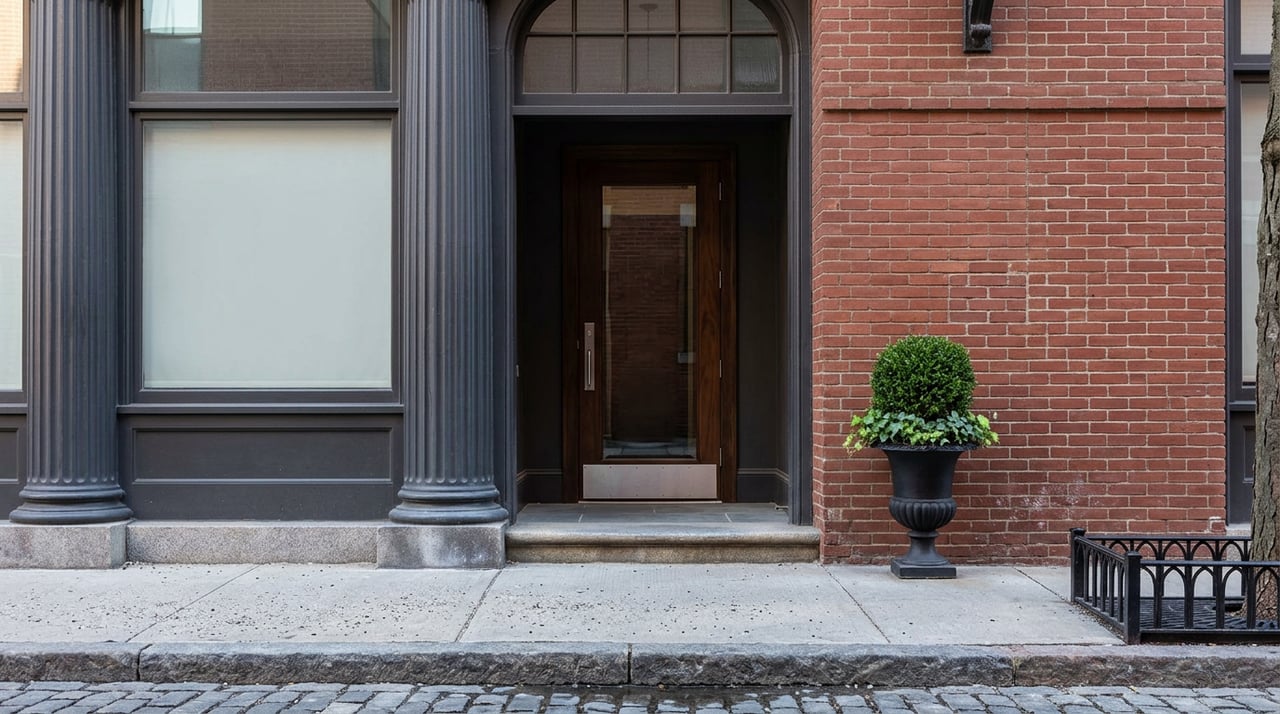
Cross Broadway at Prince Street and there is a good chance you have already stepped on the most interesting thing on the block without noticing. Carved into the sidewalk in 1984 by an artist named Ken Hiratsuka, working at night with a lookout posted in case police came by, is a chiseled granite piece that most people walk directly over on their way somewhere else. Hiratsuka reportedly looked at the corner, dark and half-abandoned at the time, and decided it needed some life. More than forty years later the corner has more life than it can hold, and almost none of the people funneling through it know the stone underfoot has a story at all.
That gap between what is happening on Broadway and what is actually worth your time this summer is the whole story of SoHo right now. The busiest version of the neighborhood this August is not the one on Broadway. It is one block over, and it has been assembled out of pieces a shopping district does not usually bother rebuilding for itself: a garden that nearly became a construction site, a used bookstore doing the work of a community center, an art calendar that refused to go quiet for the summer, and a stretch of new trash cans that says more about who actually runs this neighborhood's public space than any headline does.
Broadway Is Running Someone Else's Calendar
Walk Broadway between Houston and Canal this month and you are mostly watching a retail calendar built for tourists and event traffic, not residents. In April, Nike and Jordan Brand opened a temporary store at 611 Broadway built specifically to shift its programming with the sporting calendar, starting with the World Cup and rolling next into the US Open and then the New York City Marathon. That is the honest way to think about a lot of what opens on Broadway now. It is timed to something happening in the culture at large, not to the rhythm of a Tuesday afternoon for someone who lives four blocks away. By the time you are reading this, the World Cup signage inside that store has likely already come down in favor of whatever the brand rotates toward next.
None of that makes Broadway useless. It makes it a corridor you pass through for something specific, not a place you build a Saturday around.
The Art Calendar That Refused To Go Quiet
Most of Manhattan's serious gallery calendar goes dark for August. Dealers close up, shows come down, and the art world reassembles itself somewhere with a beach. SoHo's western edge did not get that memo this year. Three exhibitions with real institutional weight are still on view within a short walk of each other, and all three are free.
| Show | Venue | On View Through |
|---|---|---|
| Pope.L, "Certainly an Act: Works on Paper" | The Drawing Center, Wooster Street | September 27 |
| Lily van der Stokker, solo exhibition | kaufmann repetto, 55 Walker Street | August 28, with a short closure planned for mid-August |
| Edie Baskin, "Live From My Studio" | The Gallery at Soho Grand, 310 West Broadway | September 13 |
The Drawing Center itself is worth knowing beyond this one show. It was founded in 1977 by Martha Beck, who built it around the idea that drawing deserves to be treated as its own serious medium rather than a warmup for painting or sculpture, and it has held that ground in the neighborhood for close to five decades. Baskin's photographs, more than forty hand tinted images of the 1970s and 1980s cultural scene, close out at the Soho Grand gallery in mid-September, which gives you a full month left to see them without competing with the crowds Broadway pulls in on any given weekend afternoon.
If you want to do it in one pass, start at Walker Street and work west toward West Broadway. Eleven in the morning, before either gallery gets its first walk-in of the day, is the easiest hour to have the room to yourself.
The Garden That Almost Wasn't There
A few minutes past SoHo's eastern edge, on Elizabeth Street between Prince and Spring, sits a garden that is technically in Nolita and Little Italy rather than SoHo proper, close enough that most SoHo residents already treat it as their own without ever checking the neighborhood line. The SoHo Broadway Initiative does the same, listing it on its own community calendar alongside everything happening inside the corridor itself.
For more than a decade it existed under threat. The city had designated the site for a 123-unit senior affordable housing complex, a fight that pulled in preservationists, elected officials, and enough sustained pressure that the city government canceled its redevelopment plans in June 2025. That November, Mayor Eric Adams designated the garden as a city park, closing out a dispute that had run since the city took over the land in 2012. Separately, coverage at the time reported the city opted for alternate affordable housing sites elsewhere in Lower Manhattan rather than abandon the housing goal entirely.
That backstory matters because it explains why the programming running there right now is not a given. The nonprofit that operates it describes its mission plainly: protect and preserve the space, and run free public programming year round. As of this summer, Tai Chi, poetry readings, and live music are all back on the regular calendar. None of it costs anything, and none of it requires you to have discovered the garden through a guidebook. It requires walking a few blocks east of Broadway on the right afternoon.
SoHo's Actual Town Square Is A Used Bookstore
If the neighborhood has a single room that functions as common ground for residents, workers, and whoever else happens to wander in, it is the Housing Works Bookstore Cafe at 126 Crosby Street. It is a used bookstore and a cafe, but it is also a working part of the neighborhood's civic life in a way most retail on Broadway is not. It runs several events a week, including book launches, live music, and a recurring run of The Moth's live storytelling series, and every dollar the space brings in supports Housing Works' broader mission to fund housing, healthcare, and treatment access for people living with HIV and AIDS.
The clearest proof that this is where the neighborhood's actual business gets done is not the bookstore's own programming. It is who else chooses to meet there. The SoHo Broadway Initiative, the business improvement district that covers the corridor, held its own summer meet and greet for residents at Housing Works on June 26. When the organization responsible for running the neighborhood wants to sit down with the people who live in it, it picks a used bookstore over anywhere on Broadway itself.
The Infrastructure Nobody Posts About
Two pieces of quieter news explain why the side streets feel more workable this summer than they did a year or two ago, and neither one came from City Hall directly.
In June, the SoHo Broadway Initiative brought in a new set of trash bins built by a company called Citibin, each one topped with a small green roof, and installed new planters with ornamental shrubs and summer blooms in the curb extensions alongside them. The district was the launch customer for that bin model, which means the corridor is testing equipment ahead of the city's broader push toward full containerization, at its own initiative and largely at its own expense.
Then in late July, the city's Department of Transportation released an updated Phase 1 proposal for redesigning Canal Street, splitting the project into two phases and presenting the first, which covers Canal Street west of Broadway and Grand Street, to Community Boards 1 and 2. The stated goals are straightforward: relieve pedestrian crowding, simplify complex intersections, expand the bike network, and rebalance space that has gone almost entirely to vehicles for decades. It is one piece of a larger citywide push. The DOT has also been rolling out a protected two-way bike lane connecting Prince Street in SoHo up through Union Square, timed in part to handle the crowds this summer's World Cup brought to the area.
None of this is glamorous. It is also the reason a walk down a side street in SoHo this month feels less like an obstacle course than it did two summers ago, and almost none of it happened because a city agency decided to act on its own. A private district organized to run this corridor made most of the first moves.
The Version Worth Knowing
Go back to that carved stone at Broadway and Prince. It has been there for more than forty years, underfoot, at one of the most photographed intersections in the city, and most people crossing it every day have no idea it exists. That is roughly the state of SoHo itself this August. The version everyone photographs is Broadway. The version actually worth your Saturday is the garden that almost got paved over, the bookstore doing more community work than most of the storefronts around it, the three exhibitions that stayed open through the summer instead of closing, and a set of trash cans and curb redesigns nobody will ever post a photo of. None of it is hidden exactly. It is just one block over from where everyone else is looking.
If you are already living this version of SoHo, or thinking about what it would take to make it home, Ian Radoncic is always glad to talk through the neighborhood block by block. Schedule A Consultation whenever you are ready.